Unit 5 Assessment · Part 2B · Grade 12 Advanced Functions

Application AI Assignment Modelling the Bay of Fundy tides with a sinusoidal function — a complete solution, analysed against Gemini's.

Due · 4:00 PM, Thursday May 7th 2026 · GClassroom Trigonometric modelling — sinusoidal functions and their application
The model d(t) = −4.6 cos(25(t − 4)) + 7
0.0m
Low tide
Minimum · 4:00 AM
0.0m
High tide
Maximum · 10:15 AM
0.0m
Amplitude
(11.6 − 2.4) ⁄ 2
0.0m
Midline
(11.6 + 2.4) ⁄ 2
0.0h
Period
2 × (10.25 − 4)
01Your Task

Generate a problem with Gemini, then solve and analyse it.

Use Google Gemini to create an assessment-style trigonometric application problem, verify it meets every expectation, solve it completely by hand, then compare your work against Gemini's own solution.
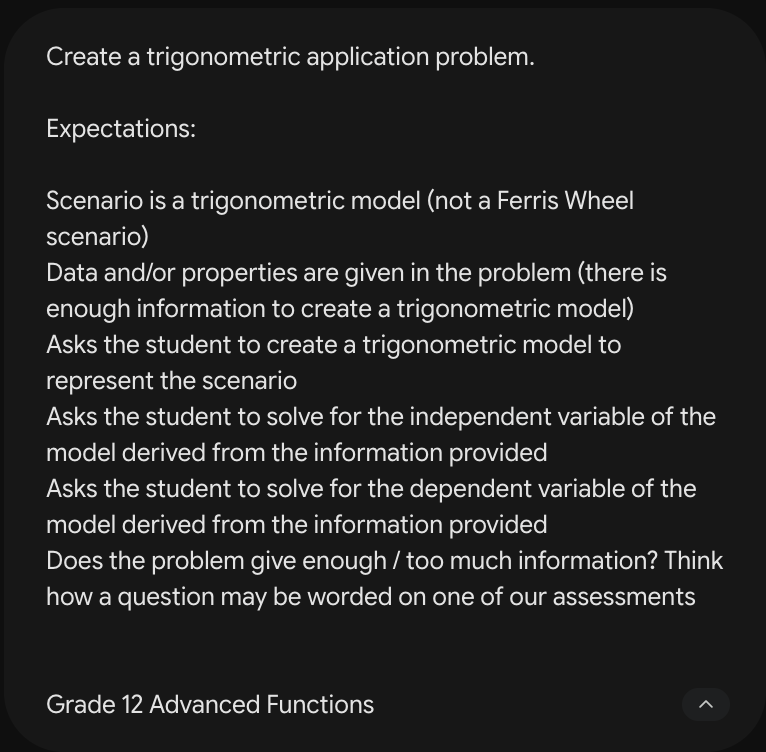
  1. Ask Gemini to create a trigonometric application problem.
  2. Analyse the problem Gemini gave and check if it meets the expectations:
    Scenario is a trigonometric model (not a Ferris Wheel scenario)
    Data and/or properties are given in the problem (there is enough information to create a trigonometric model)
    Asks the student to create a trigonometric model to represent the scenario
    Asks the student to solve for the independent variable of the model derived from the information provided
    Asks the student to solve for the dependent variable of the model derived from the information provided
    Does the problem give enough / too much information? Think how a question may be worded on one of our assessments
  3. If the above expectations are not met, prompt Gemini to edit the problem.
  4. Screenshot your prompt and the corresponding response(s) from Gemini.
  5. You provide a complete solution to the problem.
    Make sure there is no reason for tech marks to be deducted.
  6. Ask Gemini to solve the problem. Screenshot your prompt and the corresponding response from Gemini.
  7. Complete the comparison table to compare your solution with Gemini's solution.
    There should be at least 3 (in total) clear and concise similarities and differences noted. These can range from generic to specific comparisons.

02Gemini Prompt

The prompt used to generate the problem.

Gemini prompt: Create a trigonometric application problem, with the full list of expectations, tagged Grade 12 Advanced Functions.
Prompt Sent to Gemini · Grade 12 Advanced Functions

03The Application Question Gemini Created

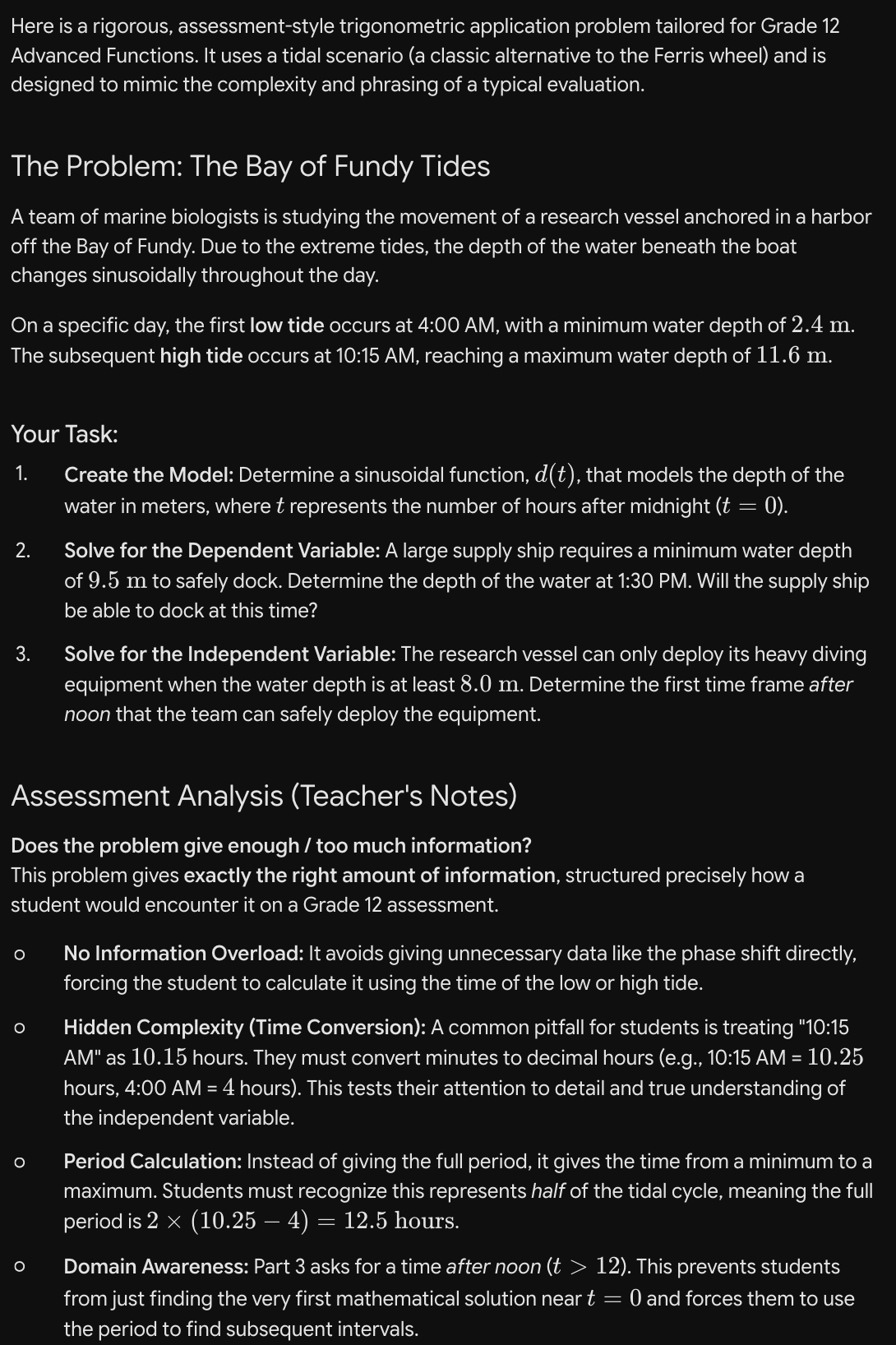
The Bay of Fundy Tides.

Screenshot must include the complete set of prompts and responses to get the question with all the expectations.
Gemini's generated problem — The Bay of Fundy Tides — with the full task and the assessment analysis (teacher's notes).
Gemini Generated problem & assessment analysis

04Your Complete Solution

The full worked solution, by hand.

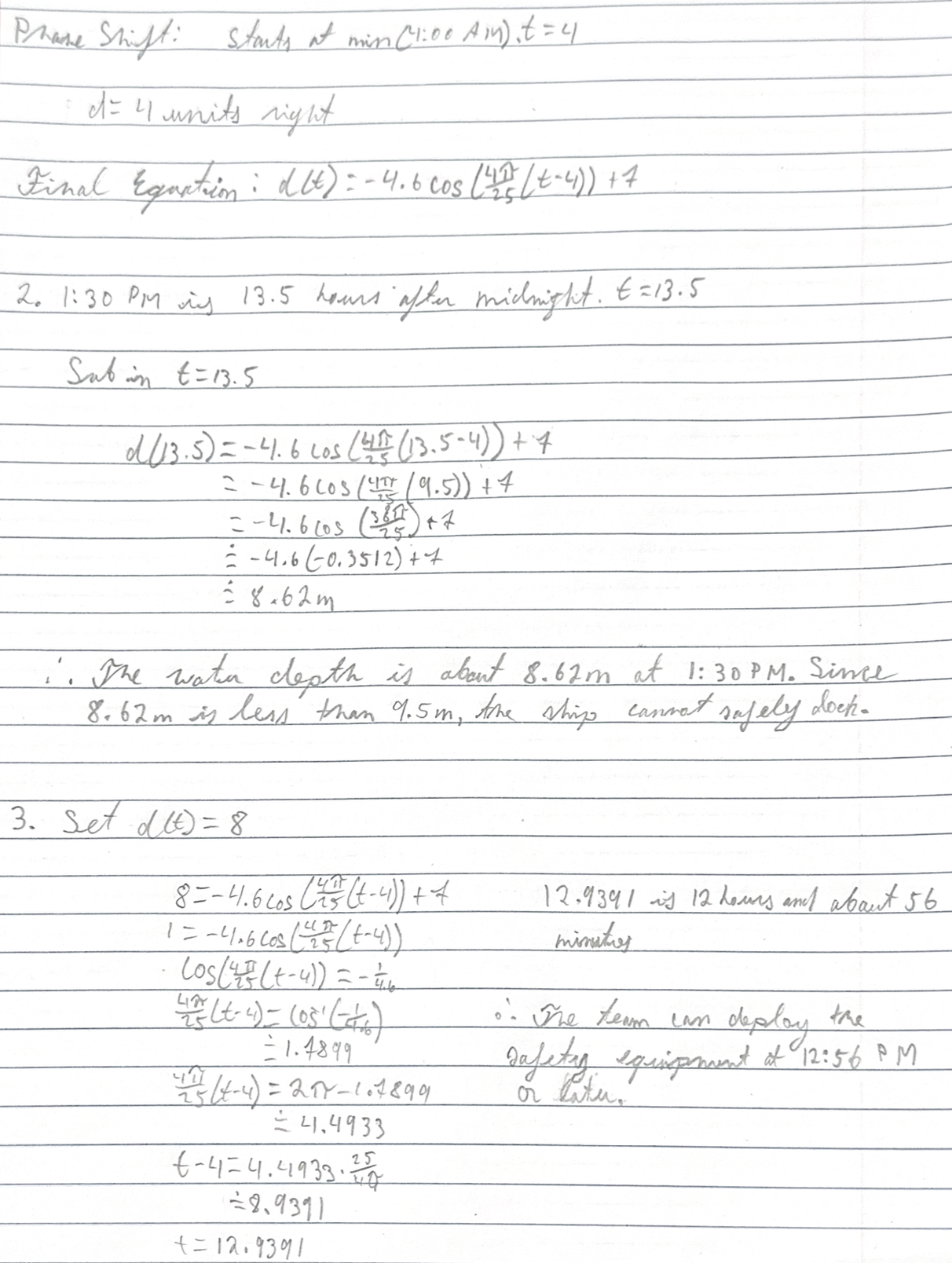
Building the sinusoidal model, solving for the dependent variable at 1:30 PM, and solving for the independent variable — the first time after noon the water depth reaches 8.0 m.
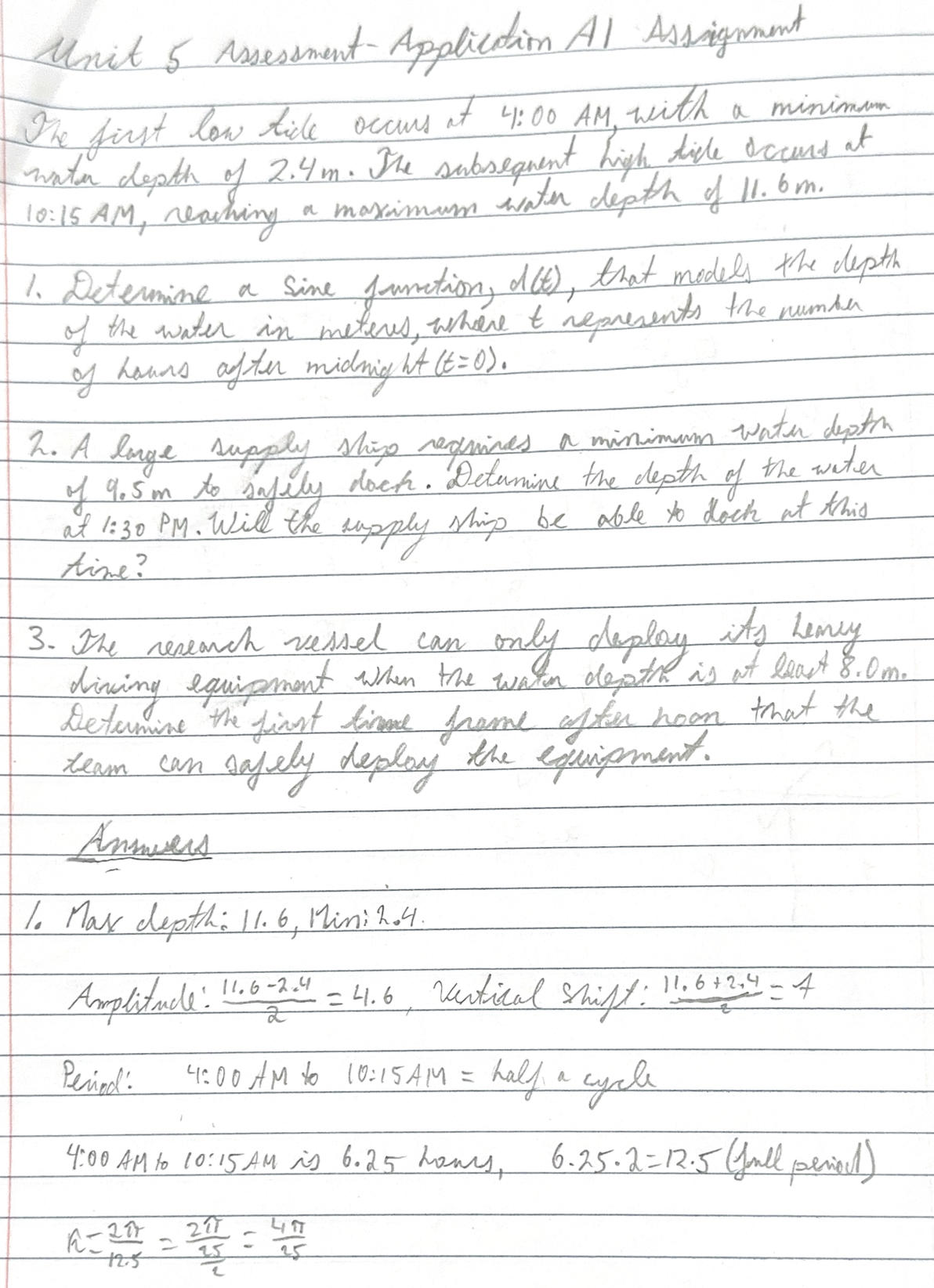
Handwritten solution, page 1: the problem restated, amplitude, vertical shift, and period calculations.
Page 1 Model — amplitude, midline & period
Handwritten solution, page 2: phase shift, final equation, solving Part 2 at t=13.5, and solving Part 3 for d(t)=8.
Page 2 Phase shift, dependent & independent variable

05Gemini Solution

How Gemini solved the same problem.

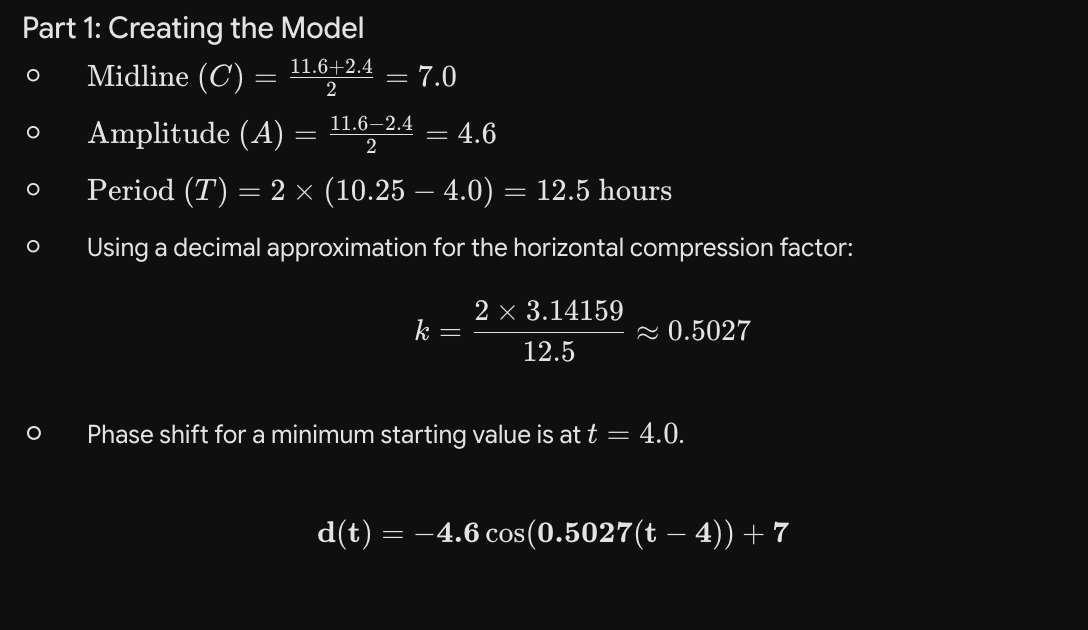
Gemini solution, Part 1: creating the model — midline 7.0, amplitude 4.6, period 12.5, decimal compression factor k ≈ 0.5027, and d(t) = -4.6 cos(0.5027(t-4)) + 7.
Part 1 Creating the model
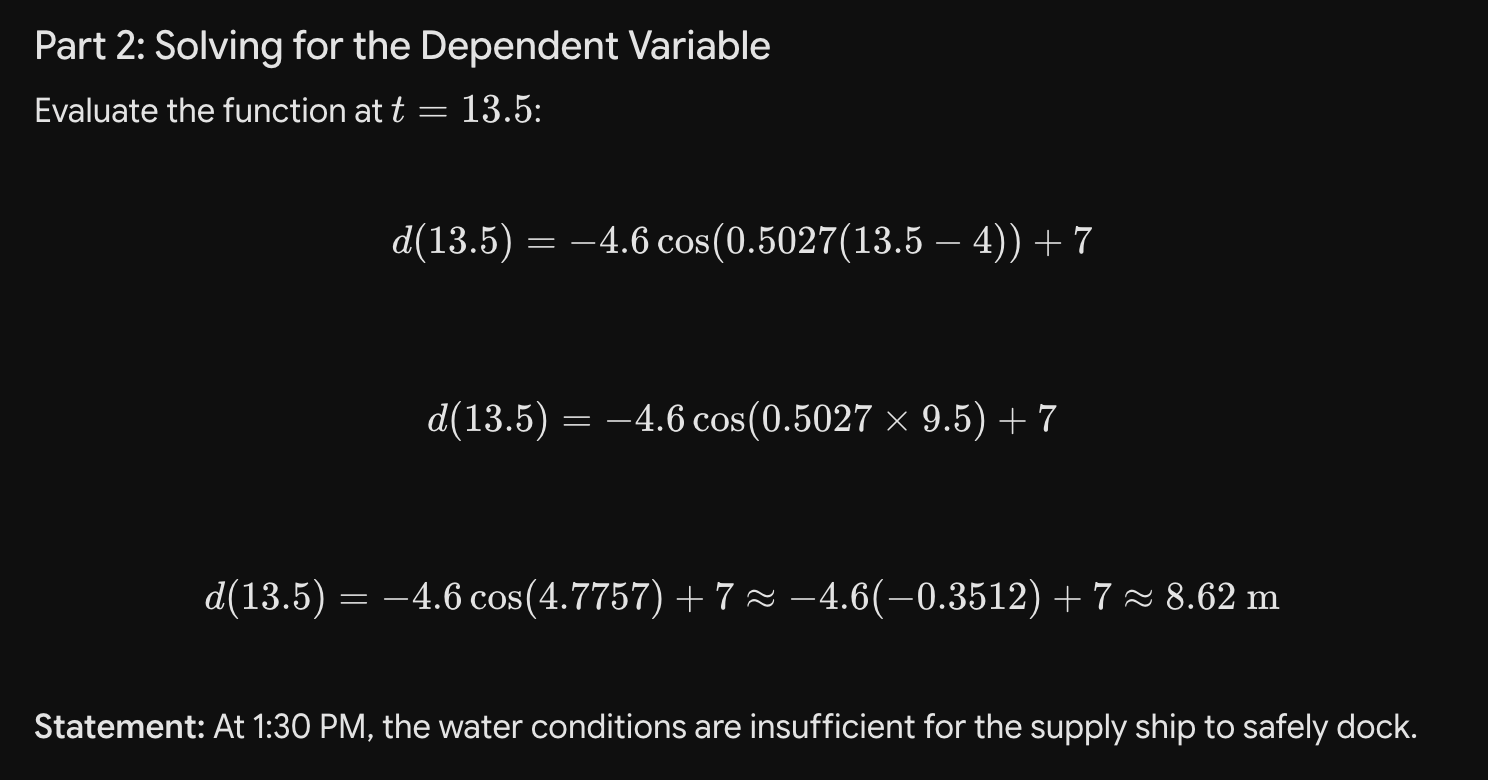
Gemini solution, Part 2: solving for the dependent variable at t = 13.5, giving d(13.5) ≈ 8.62 m.
Part 2 Solving for the dependent variable
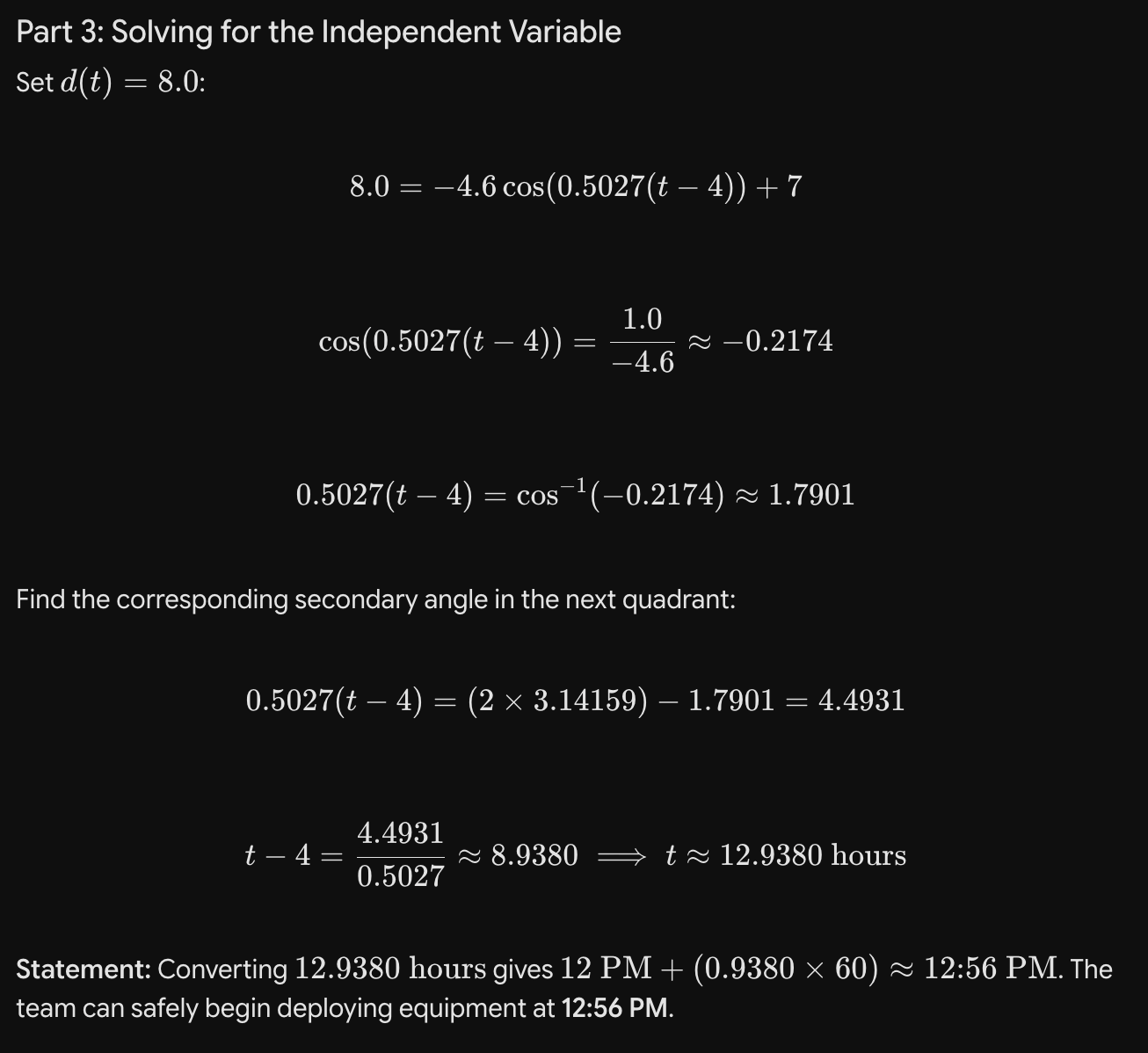
Gemini solution, Part 3: solving for the independent variable with d(t)=8.0, giving t ≈ 12.9380 hours ≈ 12:56 PM.
Part 3 Solving for the independent variable

06Comparison

My solution versus Gemini's.

At least three clear and concise similarities and differences, ranging from generic to specific comparisons.

Similarities

3 noted
  1. Both solutions have the same exact amplitude of 4.6, a midline / vertical shift of 7, and a phase shift of 4 units right.
  2. Both solutions converted the times into decimals — for example, converting 1:30 PM to 13.5 hours.
  3. Both answers say that 6.25 hours (4:00 AM to 10:15 AM) is half of a cycle.

Differences

3 noted
  1. My solution uses exact numbers by using pi, while the AI solution uses decimals — which can make some of the numbers not as accurate.
  2. The final equation is different: mine is more exact since I use pi, but the AI solution used decimals.
  3. In question 2, my therefore statement specifically states numbers like 8.62 m is less than 9.5 m… but the AI's statement is that "the conditions are insufficient for the supply ship to safely dock," without stating specific numbers — and this could result in a tech mark.

07Part 2B — Application AI Assignment Rubric

How the assessment is marked.

Criteria Level 4Excellent Level 3Good Level 2Fair Level 1Needs Improvement
Communication
Mathematical Form (Observational)
/1
The student consistently uses proper mathematical form in their written work with precision and clarity. The student generally uses proper mathematical form in their written work. The student sometimes uses proper mathematical form in their written work, but inconsistencies or errors are present. The student rarely uses proper mathematical form in their written work; significant errors are frequent.
Communication
Problem Analysis and Prompting
/1
The student thoroughly analyzes Gemini's generated problem and demonstrates sophisticated prompting to ensure all required elements for a trigonometric model are present and clear. The student analyzes Gemini's generated problem and uses effective prompting to ensure most required elements for a trigonometric model are present. The student attempts to analyze Gemini's problem and prompt for necessary elements, but the resulting problem may lack some clarity or sufficient information. The student struggles to analyze Gemini's problem or to prompt effectively, resulting in a problem that does not meet the specified expectations.
Application
Your Complete Solution
/2
The student's complete solution (including the trigonometric model and accurate solving for both independent and dependent variables) is flawlessly executed, demonstrating a comprehensive understanding of sinusoidal functions and their application. The student's complete solution (including the trigonometric model and accurate solving for both independent and dependent variables) is correct and effectively executed. The student's complete solution attempts to create a model and solve for variables, but may contain minor errors or omissions. The student's solution is largely incorrect, incomplete, or demonstrates a significant lack of understanding in creating the model or solving for variables.
Thinking
Comparison
/3
The student provides a thorough and insightful comparison of Gemini's solution to their own, identifying multiple (more than 3) clear, concise, and nuanced similarities and differences, demonstrating critical thinking and a deep understanding of the problem-solving process. The student compares the Gemini's solution to their solution and provides at least 3 clear and concise similarities and differences. The student attempts to compare the Gemini's solution to their own, but the comparison may be superficial, incomplete, or lack clarity and conciseness; fewer than 3 similarities and differences may be provided. The student does not compare the Gemini's solution to their own, or the comparison is missing, irrelevant, or incomprehensible.
Total 0 / 7